




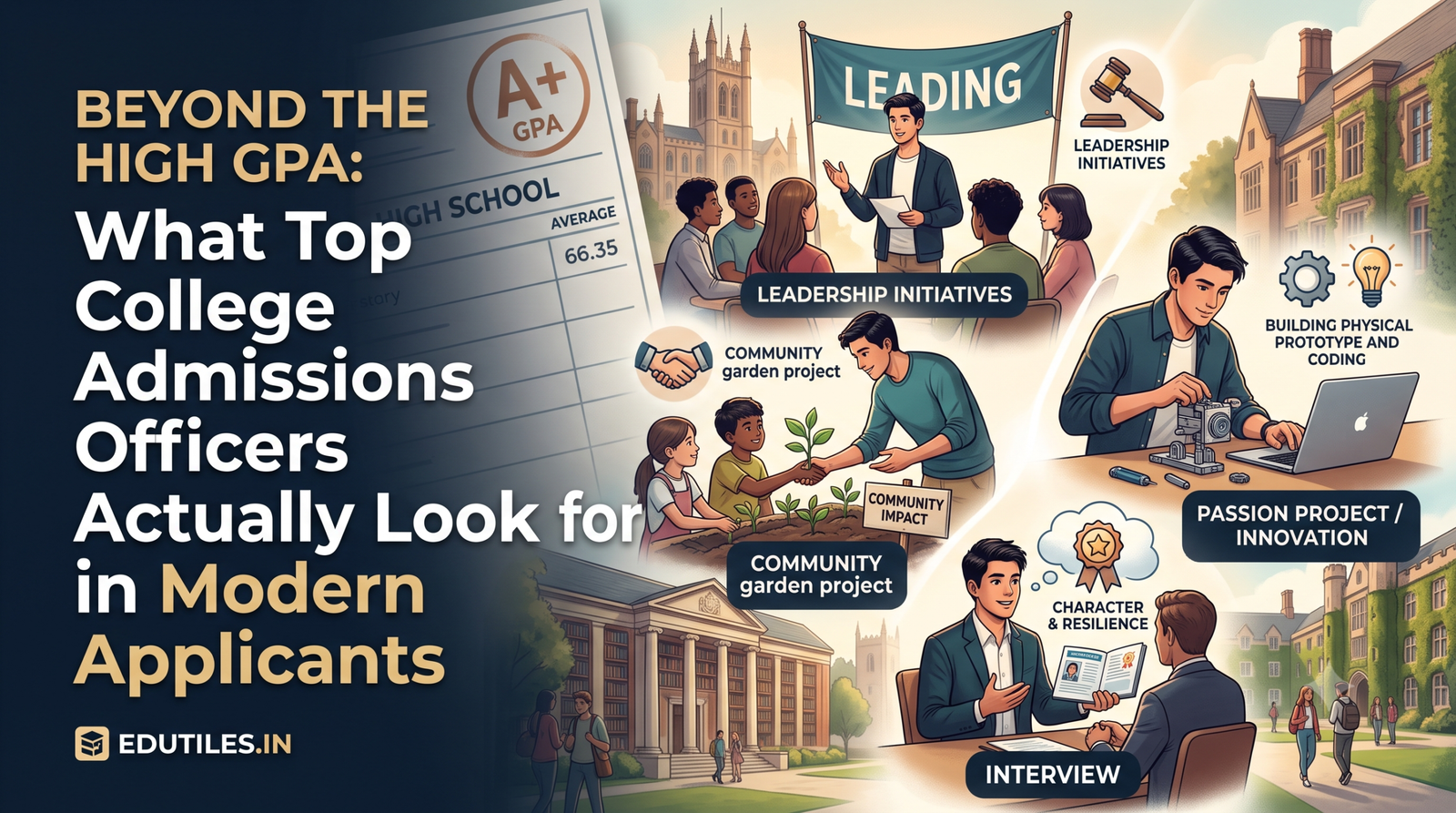

Beyond the High GPA: What Top College Admissions Officers Actually Look for in Modern Applicants
Every spring, thousands of high school seniors receive thin rejection envelopes or polite waitlist emails from selective colleges despite boasting near-perfect 4.0 GPAs, multiple Advanced Placement courses, and test scores in the 99th percentile.
The shock is understandable. For decades, academic culture conditioned families to view university admissions as a transactional formula: accumulate top grades, collect leadership titles in five clubs, log volunteer hours, and receive guaranteed entry to elite institutions.
Today, that formula is fundamentally obsolete.
Grade inflation has diluted the distinguishing power of a perfect transcript. At top-tier universities, tens of thousands of applicants present essentially identical, flawless academic metrics. A high GPA is no longer the winning factor; it is merely the price of admission. Once an applicant clears the basic academic threshold proving they can handle college-level coursework, admissions committees stop evaluating numbers and start evaluating human beings.
To stand out in the modern admissions landscape, applicants must understand the core dimensions selective admissions officers actually prioritize.
1. The “Spike” Over the “Well-Rounded” Myth
The classic archetype of the ideal college applicant was the well-rounded student: captain of the track team, concertmaster of the orchestra, class treasurer, and weekend food bank volunteer.
Admissions officers do not seek well-rounded students; they seek a well-rounded class.
A cohesive incoming class is built by bringing together a diverse cohort of deeply focused specialists: brilliant historians, inventive mechanical builders, passionate climate advocates, exceptional writers, and community organizers. When a student spreads themselves thinly across eight unrelated clubs to pad a resume, admissions committees see surface-level compliance rather than authentic curiosity.
Modern applicants distinguish themselves through what admissions experts call an intellectual or extracurricular spike. A spike is sustained, self-driven depth in a single field or intersection. Instead of joining five clubs as a passive participant, a student with a spike might:
~ Spend three years building open-source software to solve a local community logistics problem.
~ Conduct original regional archival research and get an essay published in an academic journal.
~ Launch a community initiative, secure local government grants, and build a lasting physical or educational infrastructure.
Depth signals dedication, agency, and an ability to make meaningful contributions to a university campus.
2. Intellectual Vitality: Curiosity Without an Assignment
Admissions readers frequently review files from students who excel strictly within the boundaries of what is assigned. They earn an ‘A’ because they complete the rubrics meticulously.
What committees look for—and what separates competitive candidates—is intellectual vitality: an innate drive to learn simply for the sake of knowing, completely detached from grades, test scores, or parental pressure.
Admissions officers ask:
~What does this applicant read when no test is scheduled?
~Have they pursued questions beyond the confines of their school’s syllabus?
~How do they react when they encounter complex, ambiguous problems that don’t have a single answer key?
Intellectual vitality surfaces in self-directed summer reading lists, independent research, coding prototypes built in a garage, or passionate philosophical discussions mentioned in recommendation letters. It shows that the student will energize college seminar discussions rather than passively absorb lectures.
3. Authentic Voice: The Narrative Arc of the Personal Essay
The personal statement is often treated by applicants as a written resume—a chronological recitation of trophies, titles, and academic triumphs.
Admissions officers read thousands of essays every cycle; formulaic hero arcs and standard “what I learned from winning/losing the big game” stories blend together into a blur of cliches.
Modern selective admissions committees use the essay as a window into an applicant’s inner world, self-awareness, and reflective maturity:
~Vulnerability Over Perfection: Essays that acknowledge uncertainty, mistakes, or unresolved ethical questions often leave a stronger impression than accounts of flawless achievement.
~Micro-Moments Over Grand Gestures: Grounded, vivid reflections on small, everyday interactions—a conversation during a long bus commute, a failed science experiment, or repairing a broken engine with a sibling—reveal far more character than sweeping travel summaries.
~Authenticity: An essay written in the voice of an authentic seventeen-year-old with unique observations will always outperform an over-edited piece polished by an admissions consultant into generic corporate jargon.
4. Character, Empathy, and Community Footprint
Following nationwide movements like the Harvard Graduate School of Education’s Turning the Tide initiative, top colleges place significant weight on character, ethical engagement, and emotional intelligence.
Campuses are residential communities. Committees must ask: Is this person someone others will want to live with as a roommate, collaborate with in a laboratory, or debate with in a dining hall?
This assessment is largely drawn from letters of recommendation and contextual involvement:
~ Do teachers describe the student as someone who lifts their peers, asks generative questions, and creates a welcoming classroom climate?
~ Or are they described as competitive, transactional, and focused exclusively on their own point totals?
~ Does their community involvement show sustained empathy and local impact, or is it merely superficial “voluntourism”?
Humility, resilience, and genuine kindness are rare differentiators in hyper-competitive applicant pools.
Moving Beyond the Transcript
A strong GPA and demanding course rigor will always matter—they validate that a student possesses the discipline and foundational competence to survive university academics.
However, admission to selective institutions is not an arithmetic calculation. It is a human selection process designed to assemble dynamic thinkers, leaders, and collaborators. By shifting focus from checking boxes to pursuing meaningful intellectual passions, taking risks, and contributing authentically to their communities, modern students don’t just become more compelling applicants—they build the foundation to truly thrive once they arrive.