
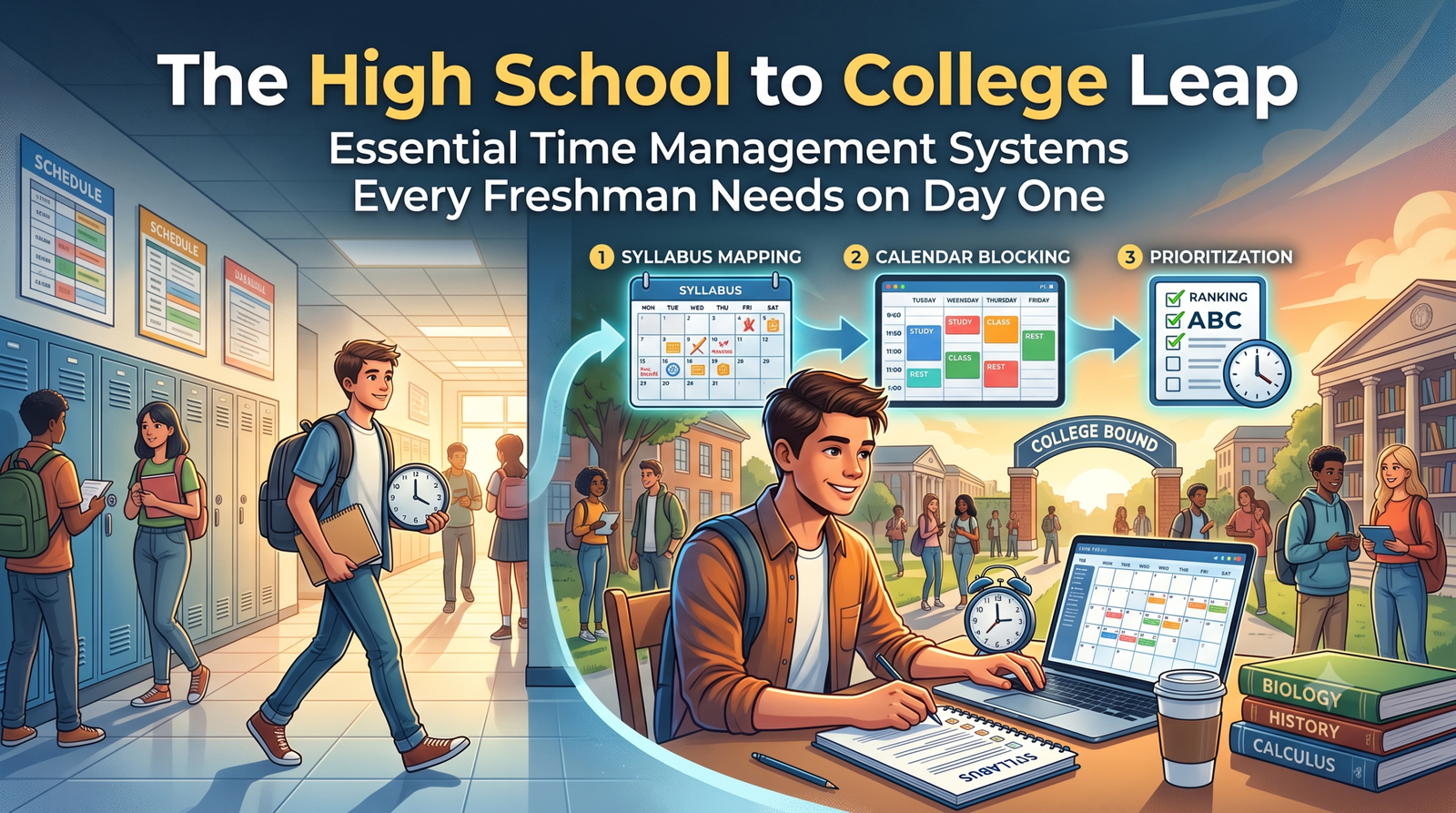
The High School to College Leap: Essential Time Management Systems Every Freshman Needs on Day One
The leap from high school to higher education is widely celebrated as an intellectual and personal milestone. Yet for the vast majority of incoming freshmen, the most daunting barrier during the first semester has little to do with advanced academic theories or rigorous textbooks. It is an abrupt collision with unstructured time.
Throughout secondary school, life is dictated by external scaffolding. Bell schedules divide the day into uniform intervals, homeroom attendance enforces punctuality, and parents and educators supply daily reminders about impending worksheets, tests, and extracurricular practices. A student’s waking hours are managed almost entirely from the outside.
College shatters this structure overnight.
A standard full-time university schedule demands only twelve to fifteen hours inside a lecture hall per week. To an unseasoned freshman, this schedule gives the illusion of endless leisure. Morning lectures wrap up by noon, leaving expansive afternoons with no mandatory checkpoints. Without an intentional framework, this vacuum quickly leads to the "freshman drift": days dissolve into scrolling social media, unstructured dorm room lounging, and frantic cram sessions when midterms suddenly appear.
Thriving in college requires replacing external discipline with self-directed infrastructure from day one. Below are four core time management systems designed to turn unstructured hours into focused academic momentum.
1. The Syllabus Audit and Reverse-Engineered Master Calendar
In high school, teachers actively manage student pacing, offering gentle nudges about upcoming due dates. College professors operate under an entirely different social contract: handing out a syllabus during week one is considered their first, last, and only warning.
During the first weekend of classes, run a comprehensive syllabus audit across every registered course:
Centralize Deadlines: Collate every single exam, paper milestone, lab report, reading discussion, and final project into one master system—whether a digital calendar or a project board.
Deconstruct Long-Horizon Projects: If an eight-page research synthesis is due in mid-November, entering only the final due date invites procrastination. Break the project into four distinct operational checkpoints:
Weeks 1–2: Topic approval and primary source gathering.
Week 3: Structural outline and thesis defense.
Week 4: Rough draft completion.
Week 5: Citations pass and final copyediting.
By converting a static final date into manageable weekly tasks, long-term anxiety is replaced with concrete micro-goals.
2. The 9-to-5 Model: Treating Daylight as Committed Time
The most common trap freshmen fall into is treating midday intervals between classes as vacation. An empty two-hour block between a 10:00 AM economics lecture and a 1:00 PM seminar is routinely squandered on casual breaks or naps. Pushing all homework to the late evening guarantees exhaustion and burns into vital sleep cycles.
Adopt the corporate 9-to-5 framework:
Anchor the Hours: Commit to treating Monday through Friday, 9:00 AM to 5:00 PM, as an active workday.
Optimize Midday Gaps: If you have an open window between lectures, head directly to a designated campus library or study hall. Use that time to review notes taken an hour prior, knock out short problem sets, or complete assigned readings.
Earn Guilt-Free Evenings: Completing six to eight hours of blended academic work during standard business hours ensures that your evenings remain entirely your own. You can attend student club meetings, socialize, exercise, or rest without the persistent dread of unfinished work hanging over your head.
3. The 2:1 Credit-Hour Benchmark
Many students stumble early because they fail to anticipate the sheer volume of independent preparation expected at university level. The standard academic formula is straightforward: for every one credit hour spent in class, plan for two hours of independent study, synthesis, and research.
Taking a 15-credit schedule implies roughly 15 hours of physical classroom time plus an estimated 30 hours of self-directed academic labor—amounting to a full 45-hour workweek.
Rather than viewing study sessions as open-ended, amorphous blocks of time, assign rigid objectives to your daily calendar:
Instead of: "Study biology on Tuesday afternoon.
"Use: "Tuesday, 2:00 PM–3:30 PM: Summarize Chapter 4 diagrams and complete practice quiz questions 1–25."
4. The 30-Minute Sunday Operational Reset
Schedules are living entities; unexpected campus events, sudden illness, or difficult problem sets will inevitably derail your plans. Without a regular recalibration point, small slips compound into an overwhelming backlog.
Set aside thirty minutes every Sunday evening to conduct an operational check:
1. Audit the Past Week: Did you miss a assigned chapter? Did an assignment reveal concept gaps that warrant visiting a professor's office hours?
2.Scan the Horizon: Identify high-stress days ahead. If a chemistry midterm falls on a Thursday, use Monday and Tuesday to absorb the primary revision load.
3.Reset the Work Environment: Clear your physical workspace, organize your digital files, and prepare backpacks and materials for Monday morning.
The True Objective: Protecting Mental Health
Mastering your schedule is not about maximizing mechanical output or filling every second with frantic productivity. Its true value lies in boundary protection.
A structured calendar protects regular sleep, consistent nutrition, authentic social connections, and mental health. When your academic obligations are accounted for systematically, you gain genuine psychological freedom. By establishing these frameworks on day one, you transition from reacting to the demands of college to actively authoring your own academic experience.