


EdTech & AI in Education: Reimagining the Architecture of LearningThis is a title
For decades, educational technology meant swapping chalkboards for smartboards and textbooks for PDFs. While digitizing the classroom modernized distribution, it left the underlying pedagogical architecture unchanged: an industrial, one-size-fits-all model operating on fixed schedules and uniform assessments.
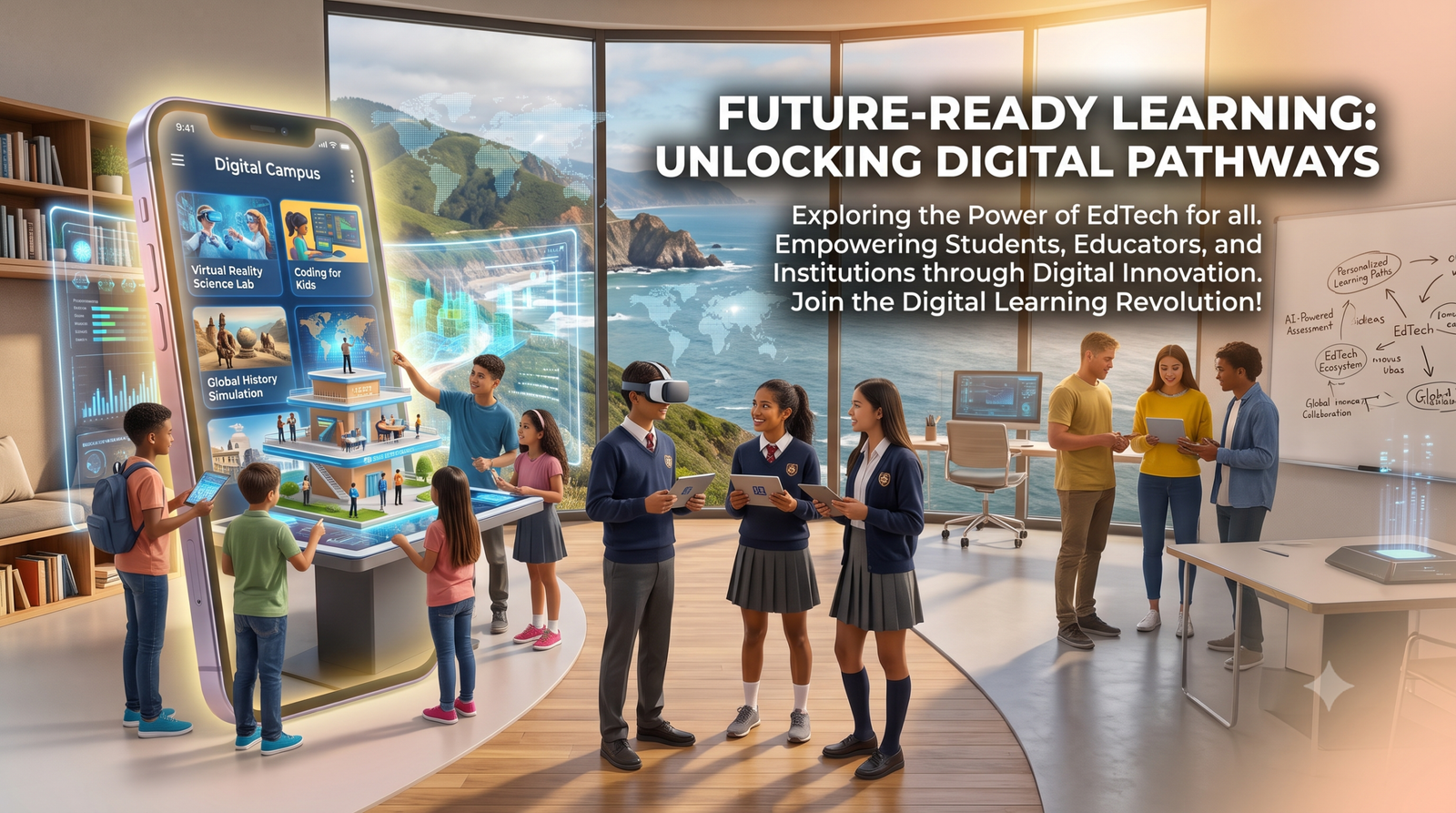
The convergence of modern Educational Technology (EdTech) and Artificial Intelligence (AI) has dismantled that paradigm. Technology in education is no longer a passive conduit for static information; it has evolved into an active cognitive partner capable of diagnosing misunderstandings, adapting instructional pacing, and unlocking personalized learning at scale.
The Evolution of Hyper-Personalized LearningThe Evolution of Hyper-Personalized LearningThis is a title
Every classroom houses a wide spectrum of cognitive styles, foundational proficiencies, and learning paces. Historically, teachers had to teach to the middle, leaving advanced students disengaged and struggling students behind. AI-driven adaptive platforms solve this core structural limitation.
By analyzing student interactions in real time—evaluating not just whether an answer is correct, but how long a student hesitated, what intermediate steps they took, and where their logic faltered—intelligent tutoring systems continuously recalibrate instructional difficulty. If a student struggles with algebraic factoring, the platform can immediately backtrack to reinforce greatest common factors using visual models. Conversely, when a student displays mastery, the software advances without forcing them through repetitive drills. This shift transforms education from a compliance-driven timeline into a mastery-driven journey.
Augmenting Educators, Not Replacing Them
A common misconception is that AI-powered EdTech aims to automate teachers out of the classroom. In reality, its greatest value lies in reclaiming human instructional time.
Educators routinely lose up to half their working hours to administrative friction: rubric grading, attendance logistics, differentiated worksheet creation, and compliance reporting. Modern generative models and workflow assistants can draft diagnostic quizzes, generate customized reading passages adjusted for different Lexile levels, and synthesize student progress notes in seconds.
When technology absorbs administrative overhead, teachers transition from content deliverers into mentors, facilitators, and emotional anchors. No algorithmic model can inspire intellectual curiosity, build empathy during a difficult adolescent transition, or detect the unspoken discouragement of a student falling behind. By automating routine logistics, AI restores the human relationship at the heart of teaching.
Expanding Accessibility and Global Equity
AI-infused EdTech is breaking down long-standing physical and socio-economic barriers to specialized instruction. For neurodivergent learners or students with disabilities, integrated assistive tools are revolutionary. Real-time voice-to-text engines, automated screen readers tailored for dyslexia, and multi-modal interfaces allow students with diverse sensory and cognitive needs to engage with identical core curricula alongside their peers.
On a macro level, mobile-first, low-bandwidth AI platforms provide students in under-resourced regions with access to high-tier academic support. An individual learner in a remote village with an affordable smartphone can interact with an on-demand tutor that explains complex physics concepts in their native dialect—democratizing access to high-caliber tutoring that was once the exclusive privilege of affluent households.
Navigating Ethics, Privacy, and Cognitive Agency
This transformation is not without friction. The integration of AI into schools surfaces urgent questions regarding academic integrity, cognitive dependency, and student surveillance.
The initial institutional response to generative AI was panic over cheating. However, unreliable algorithmic detectors and blanket bans proved counterproductive. The deeper risk is not cheating, but cognitive offloading—the danger that learners bypass the productive struggle necessary to forge neural pathways for critical analysis, argumentation, and synthesis. If an AI synthesizes every text and solves every equation, students risk becoming passive consumers of machine output rather than active thinkers.
Furthermore, student data privacy requires stringent safeguards. The predictive models underpinning educational software rely on vast telemetry datasets. Schools must ensure that pupil data is never harvested for commercial profiling and that algorithmic assessments do not reinforce historical systemic biases.
The Path Forward
The goal of EdTech is not to build frictionless, teacherless learning factories. Rather, its purpose is to create dynamic educational environments where technology handles diagnostic pacing and administrative scaffolding, freeing humans to focus on what humans do best: questioning, debating, creating, and connecting.
As education moves forward, success will not be measured by the sophistication of classroom algorithms, but by whether those tools cultivate autonomous, resilient thinkers ready to navigate an increasingly complex world.