
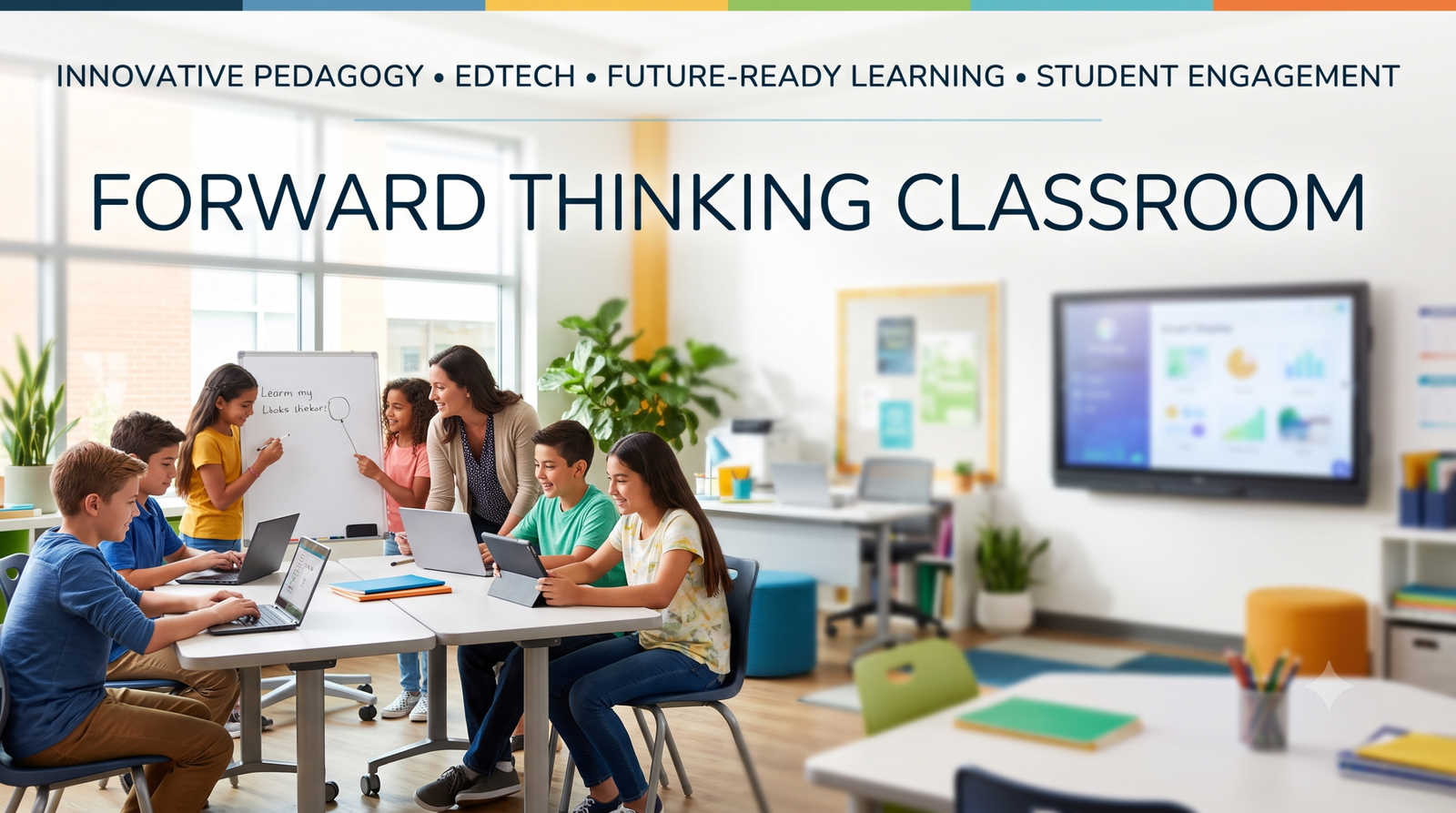
Forward-Thinking Classroom: Next-Gen Pedagogy and the Art of Active Minds
For over a century, the architectural and instructional blueprint of schooling remained remarkably frozen. Desks faced forward in rigid grids, the school bell dictated rhythm, and a solitary instructor delivered lectures from the front of the room. This industrial-era framework served a clear purpose: training students for compliance, standardized outputs, and routine labor.
Today, that paradigm has broken down entirely. When information is ubiquitously accessible and artificial intelligence can generate answers, draft code, and synthesize data in seconds, the old metrics of schooling—memorization, passive recall, and neat adherence to templates—are obsolete.
Transforming education into a forward-thinking ecosystem requires far more than merely hanging digital whiteboards or handing every child a tablet. True modernization lives in instructional design. Within the realm of Next-Gen Pedagogy & Teaching Strategies, educators are redesigning learning spaces to cultivate human capabilities: adaptability, systemic thinking, creative problem-solving, and intellectual agency.
1. From Information Delivery to Collaborative Facilitation
The historic concept of the teacher as the primary repository of knowledge—the "sage on the stage"—no longer reflects how information moves through society. When students can query any historical fact or mathematical derivation instantaneously, a teacher’s ultimate value lies in mentoring the synthesis, critique, and application of that knowledge.
~ Inquiry-Driven Scaffolding: Instead of beginning a physics unit with Newton’s third law on a whiteboard, modern facilitators begin with an unexpected physical contradiction or an engineering problem. Students make observations, debate underlying principles, and construct their own theoretical models before formalizing formulas.
~ Socratic Interrogation and Dialectic Reasoning: In an era rife with algorithmic feeds and machine-generated summaries, students must learn to interrogate sources. Forward-thinking classrooms prioritize civil debate, structured seminar circles, and rhetorical scrutiny, training learners to ask: Whose perspective is missing? What assumptions govern this model?
The educator’s job is no longer to tell students what to think, but to design rigorous environments that demand they think for themselves.
2. De-Silofed Learning: Authentic Project-Based Pedagogy
School curricula historically chopped human knowledge into disconnected 50-minute segments: biology from nine to ten, literature before lunch, economics in the afternoon. Yet no significant societal challenge—from climate adaptation to urban infrastructure—respects academic silos.
Next-generation pedagogy relies on comprehensive Project-Based Learning (PBL) that mimics real-world complexity:
Traditional Instruction
Project-Based, Next-Gen Pedagogy
Focus on memorizing isolated formulas and dates
Focus on applying concepts to authentic, messy problems
Closed-book, multiple-choice testing
Public presentations, portfolio defenses, or working prototypes
Standardized outcomes where all students do the same task
Differentiated inquiry with varied solutions and pathways
Hypothetical textbook scenarios
Local community challenges, client briefs, or open research
Whether designing sustainable irrigation models for a local community garden or analyzing demographic shifts using statistical software, PBL gives learning an immediate, tangible purpose.
3. The Modern Flipped Classroom: Meaningful Synchronous Time
The traditional flipped model—watching a recorded lecture at home and doing homework in class—has evolved. Modern pedagogy treats synchronous class time as high-value collaborative space.
Pre-Class Knowledge Acquisition: Students explore foundational concepts asynchronously via interactive modules, curated readings, or short instructional media at their own pace.
In-Class Dynamic Application: In-person sessions are reserved for debate, hands-on lab experiments, peer code reviews, or design sprints.
Low-Stakes Formative Checkpoints: Adaptive exit tickets and interactive micro-quizzes pinpoint misconceptions before class begins, allowing educators to address learning gaps in real time.
By shifting passive reception outside the room, the physical classroom becomes a buzzing laboratory of applied thought.
4. Competency-Based Education (CBE) Over Seat Time
One of the most persistent bottlenecks in education has been the assumption that learning occurs on a strict, uniform schedule. If a student earns a "C" on a foundational algebra exam, the class moves on anyway—leaving foundational cracks that widen over time.
Next-generation teaching embraces Competency-Based Education (CBE):
~ Mastery-Driven Progression: Students advance only when they demonstrate verified mastery of a core skill or standard, rather than when a calendar week ends.
~ Iterative Revision: Failure is treated as data, not a permanent grade. Learners receive actionable feedback and the opportunity to iterate, revise, and resubmit work until standards are met.
~ Personalized Pacing: Advanced learners are freed to pursue accelerated inquiry or deeper electives, while students needing reinforcement receive targeted interventions without stigma.
5. Gamification and Experiential Simulations
Gamification in modern pedagogy goes far beyond earning digital badges or points. It leverages the underlying mechanics of game design—rapid feedback loops, calibrated challenges, safe failure states, and narrative agency—to drive sustained intrinsic motivation.
Scenario-Based Simulations: Students take on roles such as diplomats negotiating climate treaties, biomedical ethicists evaluating genetic therapies, or urban planners balancing municipal budgets.
Micro-Credentials and Quest Structures: Structuring curricula into exploratory "quests" gives learners autonomy over which problems they tackle first, mirroring modern project management environments.
When failure carries zero existential penalty and acts purely as feedback to refine strategy, students develop cognitive resilience and a genuine willingness to take intellectual risks.
The Road Ahead
Building a forward-thinking classroom is not an overnight switch; it is an ongoing cultural and pedagogical shift. It asks schools to value question-asking over question-answering, iterative growth over one-shot testing, and cross-disciplinary agility over rigid curriculum pacing.
By placing modern instructional strategies at the center of the learning environment, educators don't just teach the future—they empower students to actively build it.