




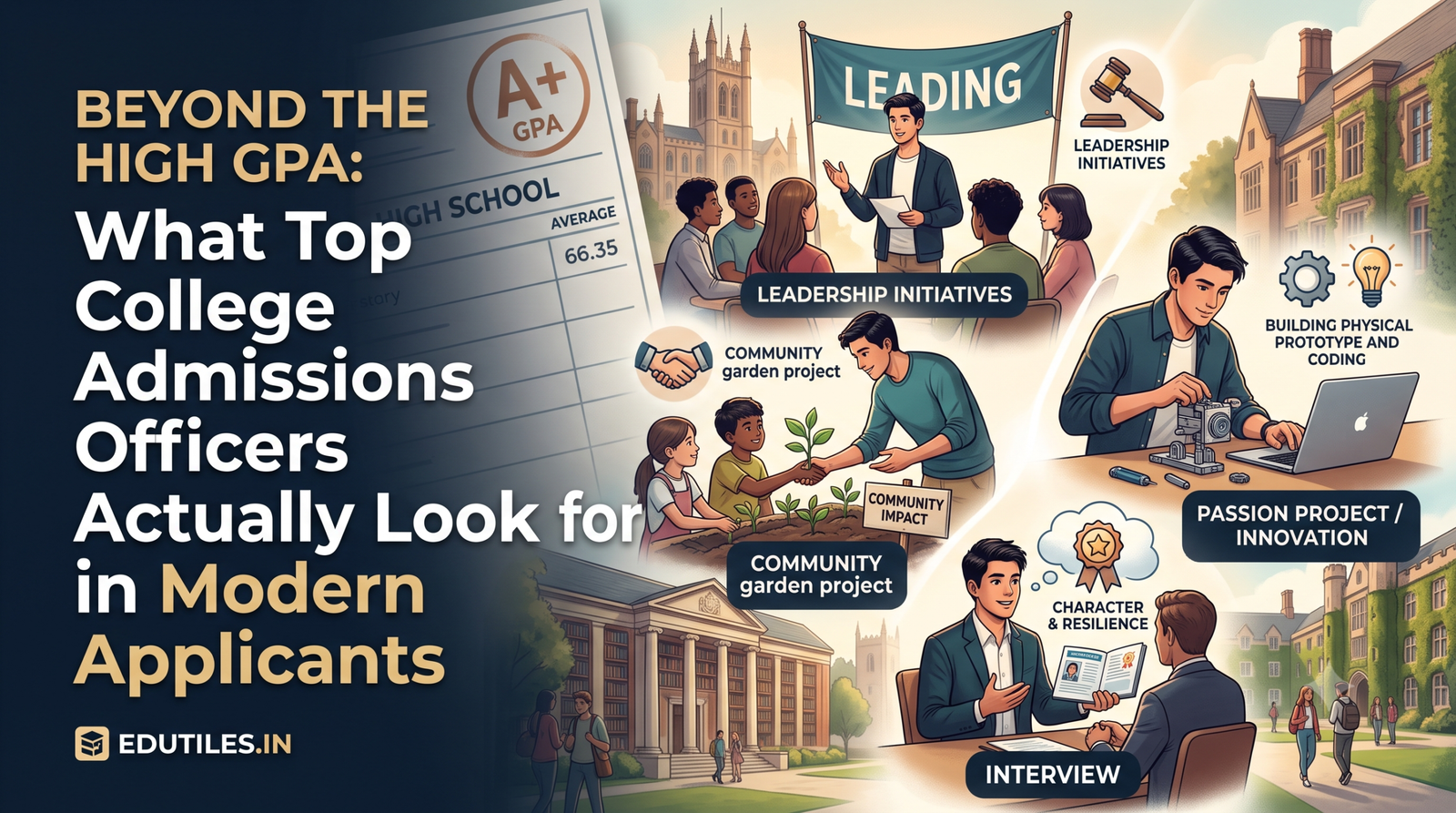

Beyond the High GPA: What Top College Admissions Officers Actually Look for in Modern Applicants
Every spring, tens of thousands of high school seniors open decision letters from elite colleges only to discover that a 4.0 unweighted GPA, a string of Advanced Placement courses, and a near-perfect standardized test score were not enough.
In today’s admissions environment, academic metrics operate merely as a preliminary threshold. A high GPA and competitive test scores answer a fundamental question for selective institutions: Can this applicant handle our academic rigor without drowning?
Once the answer is established as “yes,” those numbers largely recede into the background. Top admissions committees—faced with applicant pools where the vast majority are academically qualified—turn their focus toward a far more subjective and discerning set of criteria.
1. Demonstrated Intellectual Curiosity Over Passive Achievement
Top institutions are wary of “checkbox students”—applicants who take every advanced course and earn every credential not out of intrinsic fascination, but because they believe it fits the formula for admission.
Admissions officers look for what is commonly called intellectual vitality: an appetite for learning that spills beyond the boundaries of a classroom syllabus.
~Self-Directed Exploration: Did an interest in linguistic history lead the student to teach themselves Old English, digitize dialect recordings, or conduct independent archival research?
~Depth Over Breadth: Rather than accumulating ten unrelated high-level courses, the student demonstrates a coherent academic thread, pursuing a subject through external reading, specialized summer seminars, or original research alongside a faculty mentor.
~Reflective Synthesis: Essays and letters of recommendation illustrate that the student asks unconventional questions during discussions and genuinely wrestles with complex concepts rather than merely hunting for an “A.”
Colleges want thinkers who will enliven seminar tables and dorm lounges at midnight, not test-taking automatons whose intellectual curiosity switches off when the bell rings.
2. Distinctive Impact: The “Spike” Replaces the “Well-Rounded” Myth
The conventional advice to become a “well-rounded” student—joining six clubs, playing an instrument, running track, and volunteering on weekends—has been obsolete for years. Elite institutions do not build well-rounded classes by admitting well-rounded individuals; they build them by assembling a well-rounded class composed of deeply specialized, “pointy” applicants.
Admissions officers evaluate extracurriculars through a framework known as the “Scope of Impact”:
Tier
Profile
Perceived Admissions Value
Participatory
General member of 4–6 school clubs; basic volunteer hours
Low / Baseline
Local Leadership
Club president, varsity team captain, student council representative
Moderate; demonstrates organizational reliability
Transformative Impact
Founded a regional initiative, drafted local policy, published original research
High; demonstrates tangible execution and initiative
National / Global Scale
Nationally ranked competitor, creator of widely adopted open-source software
Rare; proves exceptional mastery and drive
What matters is not the title an applicant holds, but the tangible footprint they leave behind. Did the student merely inherit an existing school club, or did they fundamentally restructure it, secure external sponsorships, and expand its reach to neighboring communities? Admissions teams favor the self-starter who transforms their environment over the passive collector of club titles.
3. Character, Emotional Intelligence, and Context
In a holistic review system, qualitative traits carry substantial weight. Admissions teams seek to understand what an applicant will be like as a roommate, lab partner, and community member.
Authentic Voice in Essays: The college essay is not a literary resume; it is a lens into how an applicant processes their life experiences. Officers look for self-awareness, modesty, and vulnerability. An essay reflecting honestly on a personal failure or an ethical dilemma is infinitely more compelling than an overwrought narrative celebrating a championship victory.
External Validation Through Counselor and Teacher Recommendations: The most effective recommendation letters do not recite grades. They provide specific anecdotes illustrating how an applicant supports struggling peers, handles criticism, or elevates classroom discourse.
Contextual Evaluation: Admissions officers review applications through the lens of institutional context. A student who worked thirty hours a week to help pay their family’s mortgage—leaving no time for varsity sports or model UN—is evaluated for resilience and maturity, qualities prized just as highly as an elite summer internship.
4. Cohesion and Institutional Alignment
Finally, an applicant must demonstrate cohesion—a clear, credible throughline connecting their coursework, extracurricular endeavors, personal writing, and future ambitions.
When an application is cohesive, every component reinforces the same narrative:
A student pursuing environmental science who has engaged in local wetland restoration, taken advanced statistics to model climate projections, and written an essay on the economic tensions of municipal water rights presents a compelling, clear identity.
Conversely, a resume scattered across unrelated activities with disjointed essays leaves admissions officers unable to determine who the applicant actually is or how they will contribute to the campus ecosystem.
Every institution also maintains specific, shifting institutional priorities—whether that is expanding an emerging quantum computing institute, strengthening the university brass orchestra, or enrolling more students from underserved rural districts. When an applicant’s distinct profile aligns naturally with what the campus currently needs, an offer of admission follows.
A high GPA ensures an application is placed on the desk rather than in the rejection pile; it secures an audition, not a role. What ultimately earns an admission envelope is the evidence that the student possesses the self-directed drive, emotional maturity, and creative initiative to make meaningful contributions to a university community and the world beyond it.